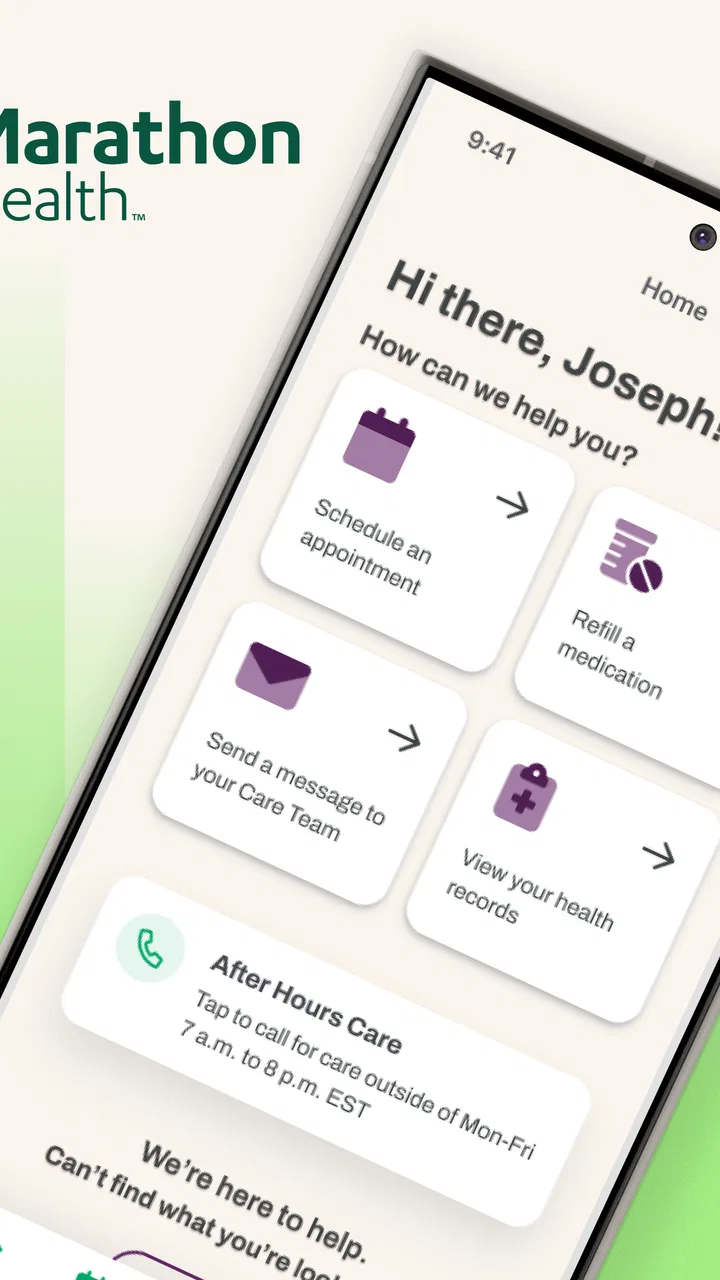
Marathon Health
- 3.5
- Rating
- 50.00K
- Installs
- Free
- Price

 Analysis by App-foxy
I approached Marathon Health as a practical medical app rather than something designed to replace a doctor, and that distinction matters. Its purpose is to sit beside your everyday healthcare routine, giving you a more direct digital connection to Marathon Health instead of making you rely only on phone calls, paper instructions, or scattered notes. The store summary, “By your side for better health,” is brief, but it points toward the app’s central role: support and access rather than dramatic medical claims.
Marathon Health is free, available to everyone by age rating, and developed by Marathon Health. It has passed the early adoption stage with more than fifty thousand installs, while its average score sits at three and a half stars from roughly two hundred ratings. I read that combination as a useful warning to keep expectations realistic. There is enough usage to suggest that people find a reason to keep it around, but the rating also says that the experience may not feel equally smooth for every user.
How Marathon Health fits into a real healthcare routine
The app makes the most sense when I think of it as a front door to an existing healthcare relationship. If your care is connected to Marathon Health, having a dedicated app can make routine tasks feel less fragmented. Instead of treating a medical app as a general wellness dashboard, I would use this one around appointments, health-related communication, and the small administrative steps that often surround care.
You May Also Like

 Blood Strike: 2.5 Anniversary
Blood Strike’s Loadouts Turn Every Drop Into a Tactical Gamble
A close look at Blood Strike’s custom loadouts: how fast access to signature weapons reshapes its battle royale rhythm, rewards preparation, and narrows the gap between fights.

 Pandora - Music & Podcasts
Pandora’s Music Is Easy to Start, but Harder to Recover
Pandora’s strength is its low-effort path from a seed to a station. Its weak spot is how much confidence it asks you to place in connection, setup, and quiet recovery.

 8 Ball Pool
 Is Built on Rivalries, Rematches, and Routine
A close look at the rivalries, rematches, shared routines, and unanswered safety questions that turn a quick pool match into a persistent mobile community.

 Samsung Music
’s Quiet Strength Is Playing What You Already Own
Its reach comes less from spectacle than from dependable access to a personal library. That simplicity is both the app’s strongest retention engine and its ceiling.

 AccuWeather: Weather Radar
AccuWeather Review: A Quick, Clear Forecast for Everyday Decisions
For everyday plans, the best forecast is the one you can understand quickly. AccuWeather makes rain timing, radar, and local conditions easy to act on, with a few trade-offs.

 Hill Climb Racing
Why Hill Climb Racing Still Turns Crashes Into One More Run
A tiny car, a bumpy hill and one more upgrade: Hill Climb Racing keeps resurfacing because its simple chaos makes every near-miss feel personal.
More From Our News Desk
View All News


A realistic example is a busy weekday when I need to check something related to an upcoming visit. I may not want to search through old messages, call during working hours, or keep several pieces of information in my head. Opening a healthcare-specific app gives me one place to begin. Even when the app does not eliminate every step, that starting point can be valuable because it keeps the task connected to the organization providing the care.
That is also why I would not judge Marathon Health by the same standards as a fitness tracker. A fitness app usually tries to motivate daily activity, display trends, or turn habits into goals. A medical app has a different responsibility. Its value is often quieter: helping me reach the right care channel, stay organized, and reduce unnecessary friction around healthcare. If that is what you need, the focused approach is a strength.
On the other hand, someone looking mainly for calorie tracking, workout plans, sleep graphs, or broad self-care content should probably choose a dedicated wellness product instead. Marathon Health is not the app I would open to count a run or compare weekly step totals. Its usefulness depends much more on whether your healthcare needs are tied to Marathon Health than on how many general health tools you want on your phone.
What the current release tells me
The current version is 2026.6.5, and the app supports Android 9 and later. That gives the product a relatively broad device reach, which is important for a medical service: people should not need a recent flagship phone just to access their healthcare tools. I also see the version number as evidence that the app has continued to receive maintenance beyond its original release on June 17, 2021.
A version number by itself does not prove that every part of the experience has been redesigned, and I would not treat it as a promise of a major new feature set. What it does suggest is ongoing product evolution. For existing users, that usually means the app is not frozen in its launch-era form. Updates can improve compatibility, correct rough edges, and adjust the way the app works as the wider service changes.
That continuing development matters more here than visual novelty. In a medical app, I would rather see dependable access and careful maintenance than constant interface changes that make familiar tasks harder to find. The best update is sometimes the one that lets me complete a routine action without having to relearn the entire app.
At the same time, updates can create their own friction. A long-standing user may open the app after an update and find that a familiar button has moved or that a sign-in step behaves differently. My practical advice is to avoid waiting until the moment of an appointment to discover how the current release works. Open the app occasionally, check that you can get past the first screen, and make sure your basic access still works when there is no immediate pressure.
What changes mean for people already using it
For an existing user, the most important question is not whether the version number looks modern. It is whether the everyday path remains understandable. I would pay attention to three things after an update: whether I can still reach the information I use most, whether notifications or messages behave as expected, and whether the app asks me to repeat setup steps. These checks take little time and can prevent an unpleasant surprise on a busy day.
There is a useful habit I would recommend to anyone using Marathon Health regularly: treat the app as a supplement to your healthcare routine, not as the only place where important information exists. Keep appointment details, instructions, and urgent contact options available through the appropriate official channels as well. A mobile app can be convenient, but a phone can be lost, a session can expire, and a connection can fail.
That is not a criticism aimed only at Marathon Health. It is a sensible boundary for any medical app. I would never delay urgent care while trying to solve a problem inside an app, and I would not assume that a digital message is the right route for an emergency. The app can help with ordinary access and organization; it should not become a substitute for immediate medical attention when time matters.
Another practical point is shared-device use. If family members use the same phone or tablet, I would be careful about leaving a medical session open. Health information is personal, and convenience should not come at the cost of privacy. The safest workflow is to sign out or lock the device when appropriate, especially if other people regularly handle it.
Where it is stronger than the usual alternatives
Compared with relying entirely on a browser, a dedicated app can feel more direct. I do not have to remember which page to visit or begin with a general search. The app gives Marathon Health a permanent place on my phone, which is useful when healthcare is something I need to access repeatedly rather than once.
Compared with ordinary phone calls, an app may also make routine contact less disruptive. Calling can involve waiting, explaining the same context again, or trying to reach the right department during limited hours. A digital route can be more comfortable for people who prefer handling simple tasks in writing or who need to fit healthcare around work and family responsibilities.
Compared with a general health hub, Marathon Health has the advantage of being tied to a specific provider. That focus can reduce the noise found in broad health platforms. I do not need a feed full of unrelated wellness advice when my immediate goal is connected to my care relationship.
The trade-off is equally clear: a provider-specific app is less useful outside that ecosystem. A general health platform may bring together records, devices, prescriptions, and services from several sources, while Marathon Health is more naturally suited to people whose care already runs through Marathon Health. If you change providers or want one universal health dashboard, another option may fit your life better.
Small workflows that make the app more useful
My first tip is to open the app before you need it. This is especially helpful after installing it, changing phones, or receiving an update. A calm test run lets you discover sign-in problems, forgotten credentials, or unfamiliar navigation without an appointment waiting in the background.
My second tip is to use it as a preparation tool. Before contacting care, I would write down the question I need answered and gather the relevant details elsewhere. That keeps the interaction focused and reduces the temptation to use a medical message as a long, disorganized diary. The app is more effective when I bring a clear task to it.
My third tip is to separate convenience from urgency. Routine questions and administrative needs may be appropriate for a provider app, but sudden or serious symptoms require the correct immediate care route. This simple distinction prevents a common mistake: assuming that because an app is medical, it is automatically the fastest channel for every medical situation.
A fourth useful habit is to review the app after a major change in your healthcare routine. If your provider, appointment pattern, or preferred contact method changes, I would not assume that my old workflow still makes sense. Rechecking where I find the information I need can save time later, particularly for people who use the app only occasionally.
Remaining gaps and everyday friction
The three-and-a-half-star average is the clearest sign that the experience is not universally effortless. I would not interpret that rating as proof that the app is poor, but I would take it seriously as a reason to expect some unevenness. Medical apps are judged harshly because users often open them when they are already stressed, busy, or worried. A minor navigation issue can feel much bigger in that context.
The app’s provider-specific focus can also become a limitation. If I want detailed personal analytics, device integration, long-term wellness coaching, or a complete cross-provider record, I would look elsewhere or use Marathon Health alongside another tool. Keeping several apps may be less elegant, but specialization is sometimes more practical than forcing one product to do everything.
I would also avoid assuming that installing the app automatically solves communication problems. Digital access still depends on having the right account relationship and on using the appropriate care channel. If the app does not get me to the right place for a particular need, the sensible next step is to use Marathon Health’s normal support or care contact route rather than repeatedly tapping through the same screens.
People with older devices should note the Android requirement of version 9 or later. That is not an especially demanding threshold for many users, but it can matter if a phone has been kept for years or no longer receives system updates. Before planning to depend on the app, I would check the device software and make sure the phone remains usable for other essential healthcare tasks too.
Who should install it, and who should skip it
I would recommend Marathon Health to people who already receive care through Marathon Health and want a convenient mobile entry point for routine healthcare needs. It is also worth considering if you dislike managing provider websites in a browser, prefer having a dedicated app ready on your phone, or want to make healthcare administration easier to fit into a crowded day.
I would be more cautious if you rarely interact with Marathon Health, want a single app for multiple providers, or are primarily looking for lifestyle coaching. In those situations, the provider connection may not justify adding another app. A general health platform, a specialist medical service, or direct contact with your care team could be a better match depending on the task.
I would also skip relying on it as an emergency tool. That is not what I want from any app. The right choice for urgent symptoms is immediate professional help through the appropriate local service, not a wait for an in-app response or a routine digital workflow.
What I would watch in future updates
Because the app has continued from its 2021 launch to the current 2026.6.5 release, I would watch how future versions balance new capabilities with familiarity. For me, meaningful progress would be measured by clearer paths to common tasks, dependable access on supported phones, and fewer moments where users have to guess what to do next.
I would also look for signs that the app is becoming more helpful without drifting into unnecessary complexity. Medical software can become cluttered when every possible function is placed on the first screen. A thoughtful update should make the most common actions easier while keeping less frequent tools available but out of the way.
Existing users should watch update notes and pay attention to changes around access, messages, appointments, and notifications. New users should judge the app after trying the workflows they actually need, not simply by its install count or store score. Those numbers provide context, but the real test is whether Marathon Health makes your own healthcare routine clearer.
My overall view is positive but measured. Marathon Health works best as a focused companion to an established care relationship, not as an all-purpose health platform. Its free access, broad age rating, continued version history, and provider-specific purpose make it a sensible download for the right audience. I would recommend trying it if Marathon Health is already part of your care, while keeping realistic expectations about what a medical app can and cannot handle.
After using it, my advice to a friend would be simple: install it ahead of time, learn the few routes you are most likely to use, and keep another way to reach care available. That approach lets the app provide convenience without making your health routine depend entirely on one screen.
FAQs for Marathon Health
01What is Marathon Health, and what can I use the app for?
Marathon Health is a digital healthcare companion for eligible members of Marathon Health’s employer-sponsored services. After signing in, users may be able to find care, communicate with healthcare professionals, schedule or manage appointments, review health information, and access wellness resources. The exact tools available can vary according to your employer, membership status, location, and the services included in your healthcare plan.
02Who can use Marathon Health, and how do I create an account?
The app is generally intended for people who receive access through a participating employer or Marathon Health program. You may need to verify your eligibility before creating an account, usually with personal details, an invitation, or information connected to your benefits enrollment. If registration does not work, confirm that your employer has activated your access and contact Marathon Health support or your benefits administrator for assistance.
03Can I use Marathon Health to schedule appointments or speak with a provider?
Depending on your plan and the services offered at your assigned Marathon Health location, the app may allow you to request or manage appointments and communicate with care teams. Some visits may be available virtually, while others require an in-person appointment. Availability can differ by clinic, provider, medical need, and operating hours, so the app should be checked for the most current options.
04Is Marathon Health a replacement for emergency medical care?
No. Marathon Health is designed to support routine healthcare access, wellness management, and communication with participating care teams, but it should not replace emergency services. For severe symptoms, serious injury, breathing difficulty, chest pain, signs of stroke, or any situation that may be life-threatening, call your local emergency number or go to the nearest emergency department instead of waiting for an in-app response.
05Is my personal health information secure when using Marathon Health?
Marathon Health handles sensitive personal and health information, so users should review the app’s privacy policy, permissions, and terms before using it. Access normally requires account credentials and may include additional verification features. Avoid sharing login details, use a secure device, and log out on shared phones. The information and features available may also depend on your employer’s healthcare arrangement and applicable privacy requirements.
Pros
- Convenient access to health resources and wellness information in one app.
- May help users track health goals and stay engaged with preventive care.
- Useful for employees seeking benefits and services through Marathon Health.
- Digital tools can reduce the need for routine phone calls or paperwork.
- Personalized features may make managing eligible health services easier.
Cons
- Many features may require an eligible employer or Marathon Health membership.
- Available services can vary depending on the employer’s benefits plan.
- Some users may find account setup and identity verification time-consuming.
- App usefulness depends on participating clinics and available local providers.
- Health data and notifications may raise privacy concerns for some users.

Marathon Health
Gallery